
Guides
Marketing goals and objectives: a practical guide for 2027
Marketing goals and objectives for 2027 connect strategy, baselines, forecasts, targets, safeguards, ownership, measurement, experiments, and review.
What to take away
- Separate strategic goals, measurable objectives, evidence-based forecasts, chosen targets, metrics, and guardrails.
- Write every objective with a population, baseline, period, formula, source, owner, assumptions, dependencies, and decision rules.
- Review objectives to allocate resources, test assumptions, correct risks, and close the period without rewriting history.
Marketing goals and objectives turn strategy into a small set of outcomes, measures, responsibilities, and decisions. A goal describes the desired direction or condition. An objective makes part of that direction specific enough to manage. A target states an intended level, a forecast states an expected level, and a metric is the defined measure used to observe progress.
For 2027, strong objective systems should connect customer value with business economics while preserving uncertainty. They need baselines, populations, time horizons, definitions, sources, owners, dependencies, guardrails, and review rules. Teams should not promise an exact result that depends heavily on customers, competitors, platforms, product delivery, or market conditions outside marketing's control.
Begin with the strategic choice
Record the chosen customer, problem, position, proof, offer, economic logic, route to market, capabilities, and exclusions. Objectives should express progress within those choices. If the strategy is disputed, a metric workshop will create false alignment. Resolve the decision and name the accountable owner first.
The U.S. Small Business Administration places goals, an action plan, budget, target market, competitive advantage, and sales plan within marketing and sales planning. Adapt the structure to business size and sector, but retain the connection between strategic intent, resources, actions, and evidence.
Distinguish goals, objectives, targets, and metrics
A goal might be to improve successful adoption among a priority customer group. An objective could specify a defined cohort, verified activation state, period, baseline, intended improvement range, source, owner, and customer guardrails. A target is the intended range; the forecast is the current evidence-based expectation; the metric is the calculation.
Keep these fields separate. Relabeling a target as a forecast can hide risk, while presenting a forecast as a commitment can encourage manipulation. A metric without an objective can generate reports without a decision. An objective without a credible measure becomes a slogan.
Audit the starting position
Review customer and market evidence, product performance, acquisition, activation, retention, sales, service, price, margin, returns, complaints, capacity, claims, data quality, prior forecasts, costs, and unresolved incidents. Separate observed facts, estimates, assumptions, targets, and strategic choices.
Build baselines for comparable populations and complete periods. Annotate launches, outages, price changes, channel changes, tracking revisions, seasonality, promotions, and one-time events. An average may conceal material variation by customer, product, market, cohort, or route.
Create an outcome tree
Start with a small number of business and customer outcomes, then map contributing conditions, behaviors, and controllable activities. Connect revenue with volume, value, margin, retention, returns, and timing. Connect customer value with successful use, effort, quality, access, satisfaction, safety, and recovery as relevant.
Mark evidence strength and dependencies on product, sales, operations, finance, service, technology, partners, or external conditions. Do not convert every branch into a primary objective. Use diagnostic measures to explain changes and guardrails to prevent harmful optimization.
Choose outcomes marketing can influence
Marketing can influence awareness, access, understanding, qualified demand, adoption support, retention communication, and customer evidence, but it rarely controls the entire business result. State the contribution and shared ownership honestly. Avoid assigning marketing sole responsibility for inventory, product quality, sales capacity, or service delivery.
Use a combination of outcome objectives and controllable commitments. An outcome objective might concern qualified customer progress; a commitment might require validated research, complete claim evidence, working handoffs, or a test delivered by a deadline. Activity counts should matter only when the work has an evidenced purpose.
Write an objective specification
State the outcome, eligible population, unit, baseline, forecast, target or range, time horizon, metric formula, source, owner, contributors, review cadence, decision threshold, assumptions, dependencies, guardrails, and limitations. Define what success, partial success, neutral evidence, and failure would mean.
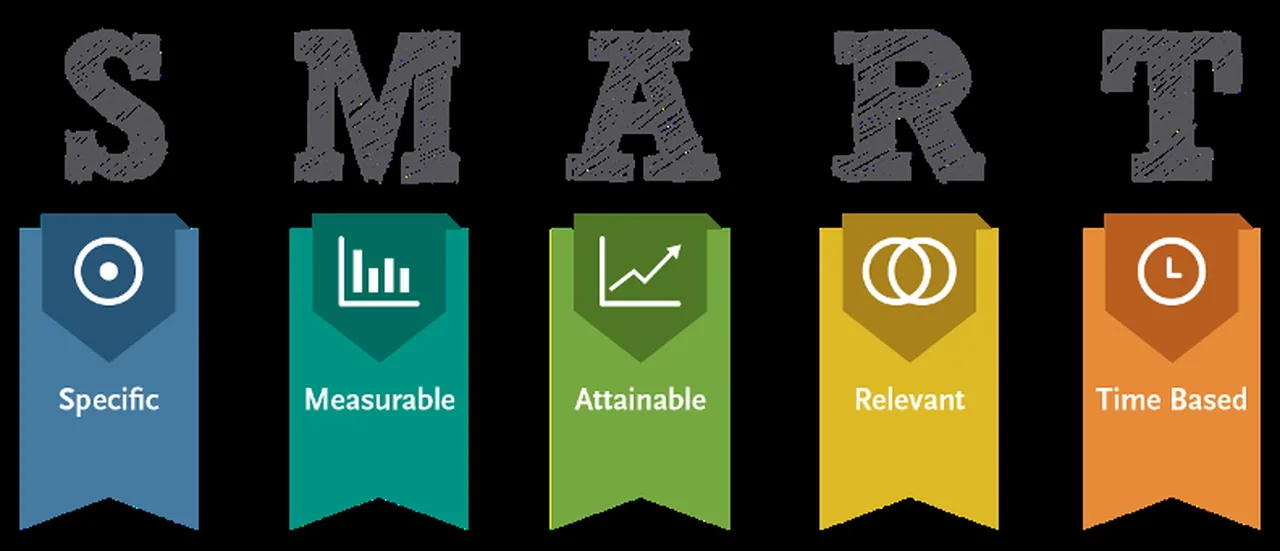
SMART wording can improve specificity, but the acronym does not establish strategic value, causality, data quality, or fairness. A perfectly measurable objective can still reward the wrong behavior. Review the full specification and expected customer consequence instead of judging the sentence alone.
Set forecasts before targets
Build conservative, central, and upside forecasts from eligible population, reach, response, qualification, conversion, value, retention, cost, capacity, and time. Show the major assumptions and sensitivity. Use historical results carefully when the offer, market, channel, price, product, or measurement has changed.
Then select an intended target based on strategy, resources, risk appetite, and improvement evidence. A target may exceed the central forecast when it represents deliberate ambition, but the gap and required changes should be explicit. Do not force a forecast upward merely to equal the target.
Define metrics before work begins
Create a metric dictionary containing business meaning, entity, population, numerator, denominator, units, currency, time zone, event, source, attribution setting, exclusions, late-data treatment, owner, refresh, correction process, and known bias. Version material changes.
Google Analytics documents separate acquisition views for new users and for sessions from new and returning users. That distinction illustrates why scope matters. User, session, event, account, opportunity, order, and cohort metrics cannot be interchanged simply because they have similar labels.
Balance leading and lagging indicators
A balanced system needs measures for both present operations and later results. NIST's performance-measurement guidance says measures should cover strategic and operational performance, include leading and lagging indicators, and support decisions and resource allocation. Use that test to remove numbers that no decision owner uses.
Leading indicators arrive early and may help teams adjust, but they are often weaker proxies. Lagging outcomes may reflect business value but mature too slowly for daily decisions. Map each early indicator to a hypothesized later outcome and regularly test whether the relationship still holds.
Do not cancel a long-horizon strategy from a noisy short-term proxy or wait for final revenue while customer harm is visible. Use a layered cadence for incidents, data quality, active delivery, customer progress, economics, and mature outcomes.
Use guardrails and constraints
Pair each primary objective with measures that protect margin, quality, customer fit, accessibility, privacy, claims, frequency, fulfillment, returns, complaints, service load, retention, and employee capacity as appropriate. A guardrail should have an owner, threshold, monitoring frequency, and response.
The U.S. Federal Trade Commission states that advertising claims must be truthful, non-deceptive, fair, and evidence-based. An aggressive objective never justifies unsupported claims or hidden terms. Other countries and regulated categories may impose additional duties requiring qualified review.
Plan resources and dependencies
Estimate research, creative, media, content, technology, analytics, sales, service, product, finance, legal, privacy, accessibility, operations, vendors, approvals, and management capacity. Include revision, quality assurance, localization, training, incident response, and maintenance.
Assign one accountable owner for the objective and named owners for dependencies. Define acceptance criteria, service levels, escalation, and backup. If the target assumes more demand than the organization can fulfill, revise the plan before generating that demand.
Connect initiatives with objective logic
For each program, state the customer, need, offer, channel role, evidence, cost, primary objective, diagnostic measures, guardrails, dependencies, and stop rule. Explain the mechanism by which the initiative should affect the objective. Avoid attaching every campaign to every company goal.
Build a portfolio of maintained programs, launches, tests, research, infrastructure, retention, partnerships, and reserves. Review coverage, duplication, concentration, timing, and capacity. Objectives should guide resource choices, including what will stop.
Test important assumptions
Prioritize assumptions that are uncertain, consequential, and testable. Predefine the decision, hypothesis, comparison, assignment, primary outcome, guardrails, sample need, duration, contamination risk, stop rule, and analysis. Preserve neutral and negative results.
When controlled experiments are not feasible, use phased rollouts, matched comparisons, time-series analysis, or qualitative research with explicit limitations. Do not claim causality from a simple before-and-after result without considering seasonality, mix, competitors, price, product, and measurement changes.
Prevent objective gaming
Review how a metric could be improved without creating the intended value. Cheap leads can reduce sales quality; registrations can increase no-shows; shorter service time can reduce resolution; higher order volume can raise returns. Add downstream checks and audit unusual shifts.
Avoid tying incentives to one narrow metric without quality and conduct controls. Encourage documented learning and responsible stops, not only positive results. Make it safe to surface broken tracking, missed forecasts, and invalid assumptions before they grow.
Run a decision-focused review
Every review should state what changed, why it matters, data quality, confidence, competing explanations, forecast impact, proposed action, cost, owner, and next check. Separate observation from interpretation and decision. Match cadence to the speed of risk and outcome maturity.
Preserve the original baseline, forecast, target, and objective specification. Log changes with evidence, approver, affected work, and effective date. A revision based on learning is healthy; silently rewriting the prior expectation prevents learning.
Close objectives properly
At the end of the period, reconcile spend, commitments, outcomes, customer effects, incidents, data corrections, and unresolved dependencies. State whether the objective was achieved, partially achieved, not achieved, invalidated, or no longer relevant. Explain confidence and causal limits.
Archive the specification, evidence, decisions, and reusable assets. Carry forward validated baselines, cycle times, economics, and forecast error. Do not automatically renew an objective merely because it appeared on the prior plan.
Use a practical 2027 objective cycle
- Confirm strategy, customer, value, economic logic, scope, owner, and exclusions.
- Audit evidence, baselines, data quality, prior forecasts, customer effects, capacity, and risks.
- Build an outcome tree and select a small number of customer and business outcomes.
- Write objective specifications with forecasts, targets, definitions, assumptions, guardrails, and dependencies.
- Allocate initiatives and resources through explicit mechanisms, acceptance criteria, and stop rules.
- Validate events, handoffs, fulfillment, source data, and reporting before launch.
- Test consequential assumptions and monitor incidents, quality, progress, economics, and mature outcomes.
- Review decisions, preserve changes, close the period honestly, and carry verified learning forward.
Good marketing goals and objectives create disciplined focus without turning uncertainty into a promise. They show what value matters, how it will be observed, what marketing can influence, what other teams must deliver, what must not be harmed, and which evidence will change the plan. That makes objectives tools for decisions rather than decorations for dashboards.
Objective design record
| Design question | Required evidence | Decision effect |
|---|---|---|
| What should change? | Outcome, entity, population, period | Defines success |
| What is plausible? | Baseline, forecast, assumptions | Frames the target |
| What protects value? | Guardrails, capacity, dependencies | Constrains action |
| Who decides? | Owner, threshold, cadence, closure rule | Creates accountability |
Verify marketing goals and objectives before release
For marketing goals and objectives, the GAO evaluation design guide explains how evaluation questions, evidence needs, and design choices fit together. The guide is written for federal program evaluation. Use its design discipline as a check on the method, not as proof that a marketing result is causal or transferable.
The W3C Privacy Principles statement gives system designers a shared vocabulary for privacy and warns against shifting privacy work onto individuals. Apply that principle to the data flow behind marketing goals and objectives. It does not replace the law, contract terms, consent analysis, or a review of the actual configuration.
The GOV.UK technology selection guidance recommends choices that can change over time, preserve data control, address security risk, and include ownership cost. Those public-service rules become useful buying questions for marketing goals and objectives, but they are not private-sector mandates or product endorsements.
Apply these checks to the actual marketing goals and objectives workflow. Record the tested data, roles, product versions, exceptions, and approval date. Repeat the review after a material source, model, access, contract, or decision change. The added sources define separate evaluation, privacy, and operating questions; none certifies the local implementation or supplies a guaranteed marketing result.
Common questions
What is the difference between a marketing goal and an objective?
A goal states an intended direction or condition. An objective specifies a measurable outcome, population, period, evidence, and owner.
Should a marketing target equal the forecast?
No. The forecast records the evidence-based expectation, while the target records the intended result and the resources or risk needed to pursue it.
How many primary marketing objectives should a team use?
Use the smallest set that represents real strategic tradeoffs and resource decisions, with diagnostic measures and guardrails kept secondary.