Strategy
Advertising agencies specialties compared: brand, media, and performance work
Advertising agency specialties split into brand, media, and performance work, and the named shops that run each model differ on fees and control.
What to take away
- Advertising agency specialties split three waysbrand positioning, media inventory, and measured performance.
- Wieden+Kennedy and Ogilvy sell creative and brand systems; GroupM and Publicis Media sell buying scale.
- Performance shops such as Tinuiti and Croud bill on retainer or percentage of spend, not on outcomes alone.
- Ask any agency whether it buys media through its own trading desk, because that decides who sees the margin.
- Match the specialty to the decision you cannot make in-house, then price the coordination it creates.
Brand, media and performance agency models
Brand agencies sell positioning and creative systems. Wieden+Kennedy, founded in Portland, Oregon, in 1982 and still independent, wrote "Just Do It" for Nike in 1988. Campaign fees at that level typically start near $100,000, billed by project or retainer.
Ogilvy, founded in New York in 1948 by David Ogilvy, is owned by WPP and runs brand strategy and creative at holding-company scale. TBWA, part of Omnicom, sells a disruption method and has held Apple's advertising account since 1997. Droga5, founded in New York in 2006 and bought by Accenture in 2019, pairs creative with consulting.
Media agencies sell planning and buying across channels. GroupM, WPP's media arm, negotiates inventory through Mindshare, Wavemaker and EssenceMediacom. Publicis Media runs Starcom, Zenith and Spark Foundry, and sells audience data alongside buying. Omnicom Media Group covers OMD and PHD. Horizon Media, independent and based in New York, is the largest non-holding-company buyer in the United States.
Their economics rest on volume, so their advice favors reach over narrow tests. Commission on gross media spend was traditionally 15 percent. Large advertisers now often negotiate 3 to 10 percent of spend, plus a flat planning fee.
Performance agencies sell measurable response. Tinuiti and Croud run paid search, shopping and paid social against revenue or lead targets. They bill a retainer or a percentage of ad spend, which means their fee rises when your budget does.
Wpromote, based in El Segundo, California, handles paid media and SEO for mid-market ecommerce brands. PMG, an independent shop in Dallas, runs media and creative for consumer brands. Performance retainers typically run $3,000 to $25,000 a month, or 10 to 15 percent of spend.
Named brand, media and performance agencies compared
| Agency | Specialty | Who it suits | Pricing model |
|---|---|---|---|
| Wieden+Kennedy | Brand and creative | Consumer brands needing a distinct voice | Project or retainer; campaigns typically from $100,000 |
| Ogilvy | Brand, creative, integrated | Large advertisers wanting one holding company | Retainer plus production, typically seven figures a year |
| TBWA | Brand and disruption | Established brands defending share | Annual scope retainer |
| Droga5 | Brand and creative, Accenture Song | Brands buying creative plus consulting | Project fees |
| GroupM | Media planning and buying | Advertisers with seven-figure budgets | Commission or fee on spend, typically 3 to 10 percent |
| Publicis Media | Media and data | Brands wanting buying plus audience data | Fee on spend, typically 3 to 8 percent |
| Omnicom Media Group | Media planning and buying | Large advertisers using OMD or PHD | Fee on spend, sliding with volume |
| Horizon Media | Independent media buying | US advertisers avoiding a holding company | Fee on spend or flat retainer |
| Tinuiti | Performance, retail media | Ecommerce and marketplace sellers | Retainer or 10 to 15 percent of spend |
| Croud | Performance, paid search | Mid-market advertisers wanting flexible teams | Retainer, spend-linked |
| Wpromote | Performance, paid media and SEO | Mid-market ecommerce brands | Retainer, typical market range $5,000 to $25,000 a month |
| PMG | Performance and creative | Consumer brands with in-house media teams | Flat retainer plus target bonus |
The split matters because the fee follows the specialty. A brand agency is paid to make choices you keep. A media agency is paid to move budget. A performance agency is paid to grow the account it bills against.
Where the models collide
Most disputes trace to one question: who owns the buying decision. When a media agency runs its own trading desk, the advertiser often cannot see the margin between the price paid and the price billed. GroupM routes programmatic buying through Xaxis; Publicis Media uses its PMX desk. Ask for the reconciliation.
Performance shops carry the opposite risk. A percentage-of-spend fee rewards more spend, not better spend, so a flat retainer with a bonus tied to your target usually aligns better. Set the target in your own analytics, not the agency's dashboard.
Regulated categories add a third layer. Health, financial and children's advertising face rules set by the Federal Trade Commission and, in Canada, the Competition Bureau. No agency can settle those questions for you; confirm claims with qualified counsel before the creative is approved.
Build the roster, then the record
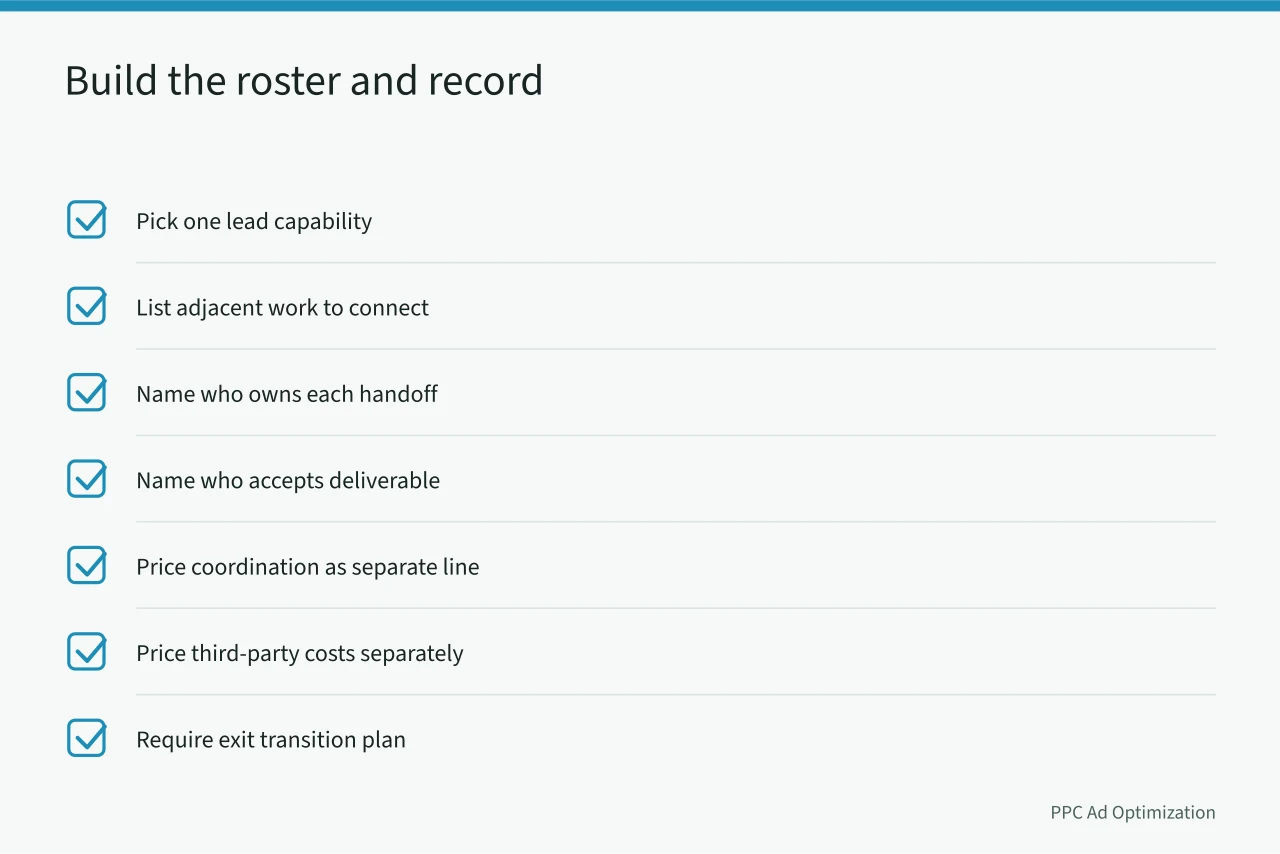
Pick one lead capability for the assignment, then list the adjacent work that must connect to it. Name who owns each handoff and who accepts the deliverable. Price coordination and third-party costs as separate lines, and require a transition plan for accounts, data and files at exit.
A specialist roster beats one large agency when roles are clear and you can integrate the output yourself. One lead agency cuts handoffs when it has genuine depth and open economics. Our guide to choosing advertising agencies scores team location and role clarity as evidence.
Keep the reasoning next to the decision. The GAO evaluation design guide links evaluation questions to the evidence they need, which is the discipline to apply here. The W3C privacy principles cover data handling in the same way: name the principle, then check the configuration.
The media buying checklist covers planning, account access and supplier exit. The U.S. Bureau of Labor Statistics lists advertising and marketing manager duties such as budgets, contracts and media choices, which is the work you are buying. For the wider market of advertising agencies, treat every specialty label as a claim to verify.
Common questions
What is a full-service advertising agency?
It offers or coordinates several disciplines, usually strategy, creative, production, media and measurement. Ask which parts run in-house and which are subcontracted, because that answer sets your cost and your control.
How do the three specialties differ on fees?
Brand work is priced by project, media buying by a percentage of spend, and performance work by retainer or a share of spend. Ask for the assumption behind each number, because the fee shape tells you what the agency is rewarded to grow.
When is a specialist agency the better buy?
When one capability decides the result: a retail feed, a regulated category, a single channel. A specialist is cheaper than a generalist learning your category on your budget.
Can two specialties overlap without duplicate fees?
Yes, if you define which agency owns each decision and each deliverable. Overlap turns into duplicate fees when two teams hold authority over the same choice.
Does a percentage-of-spend fee align the agency with me?
Only partly. It rewards growth in spend, not efficiency, so pair it with a flat retainer and a bonus tied to a target you measure yourself.