
Strategy
How to Set a Small Business Marketing Budget: The Parts Worth Your Time
how to set a small business marketing budget in 2027 using cash guardrails, commercial goals, complete costs, funnel ranges, test gates, and monthly controls.
What to take away
- Set the maximum affordable cash loss before dividing money among channels.
- Translate a commercial objective into ranges for customers, qualified opportunities, activity, costs, and contribution.
- Approve a base case, a lean response, and an expansion case with owners, evidence gates, and monthly reviews.
How to set a small business marketing budget begins with a commercial decision and a cash limit, not a copied percentage. Planners often start with a typical range of 5 to 10 percent of revenue for service businesses and 8 to 15 percent for retail and consumer products.
The cash ceiling and the contribution math still decide the final number. The following sequence produces a plan that an owner, marketer, accountant, and operator can inspect.
1. Set the financial guardrail
Australia's business-budget guide distinguishes a budget, a financial plan, from a forecast built from current data and trends. The United States Small Business Administration and Canada's Business Development Bank publish similar budget and cash-flow worksheets.
It recommends identifying fixed and variable costs, comparing actual results with the plan, and updating forecasts more often than the annual budget.
Apply that distinction to marketing so a profitable annual plan does not hide a monthly cash shortage.
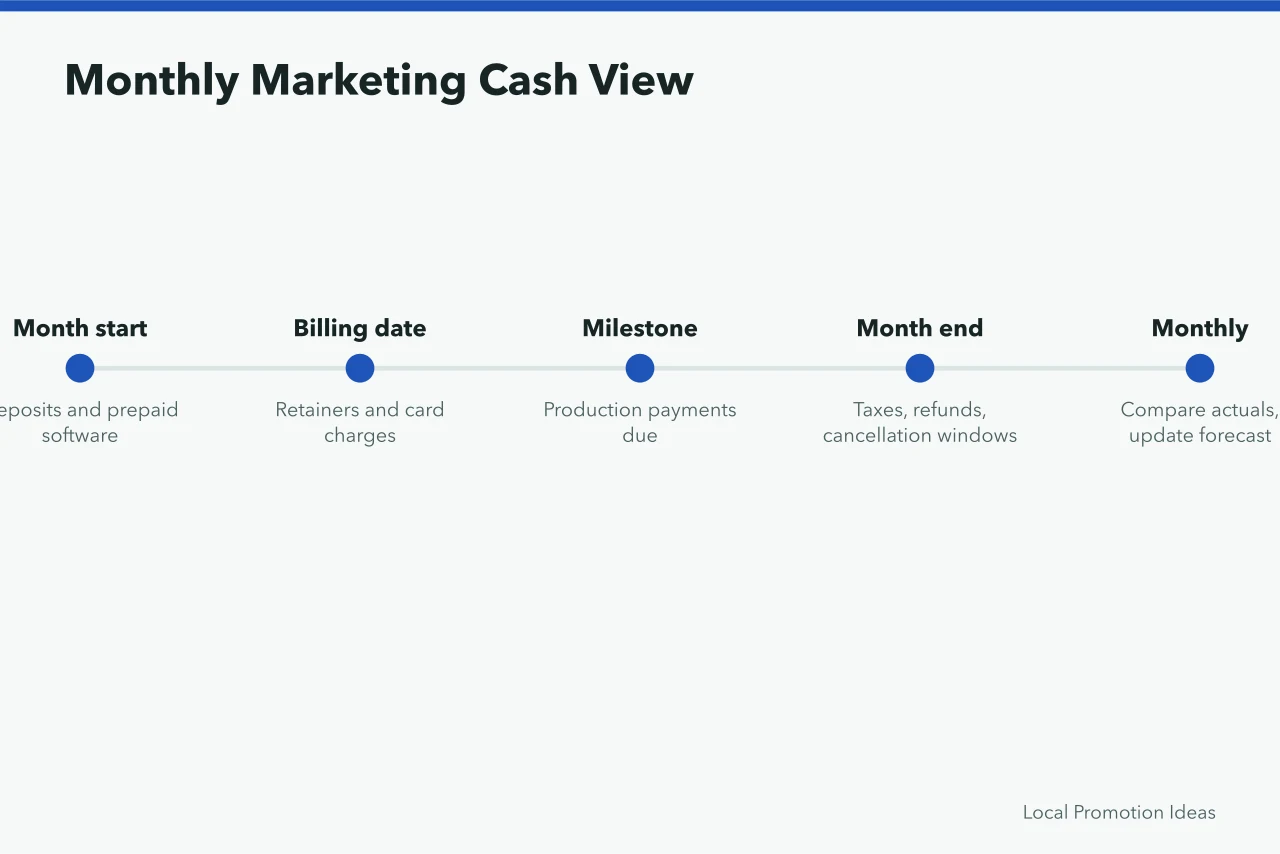
Create a monthly cash view beside the annual allocation. Mark deposits, prepaid software, retainers, production milestones, card billing dates, taxes, refunds, and cancellation windows.
Forecast cash by month after essential costs, tax, debt, payroll, owner obligations, inventory, and reserve needs. Define an annual ceiling and lower monthly limits.
2. Define the objective
Australia's marketing-plan guidance connects target-market definition, positioning, goals, channels, activities, a basic budget, and evaluation. Use that sequence to state who should act, what offer they receive, the relevant geography and period, the business outcome, and the evidence needed. A budget line without a customer, purpose, owner, and decision date is only a spending category.
Name the customer, offer, geography, action, quantity, deadline, contribution target, and operational capacity. Separate acquisition, retention, launch, research, and brand objectives. A budget cannot resolve conflicting goals that have no priority.
3. Calculate a complete cost
List internal hours, agencies, media, production, software, data, print, events, offers, landing pages, tracking, sales follow-up, compliance, taxes, and contingency. Mark fixed, variable, and committed items.
4. Model the economics
Estimate contribution per sale, refund and cancellation rates, repeat contribution supported by observed retention, payment delay, and service capacity. Work backward from customers to qualified opportunities, leads, visits, and media using ranges.
5. Allocate tests and proven work
Protect the strongest repeatable activity, customer communication, measurement, and a limited learning fund. For each test, write the maximum loss, minimum observation period, evidence threshold, stop rule, owner, and next use of the money. Before setting the learning fund, review small business marketing strategy mistakes like channel-first plans and weak offers that can waste that money.
6. Install controls
Set platform limits, card alerts, invoice approval, naming rules, cost reconciliation, and change thresholds. Budget types, pacing, automation, and billing can differ by platform, account, campaign, and market, so reconcile every setting and invoice with the business ledger.
7. Review and reforecast
Compare budget, commitments, actuals, forecast, pipeline, contribution, cash, and service impact monthly. Explain variance. Reallocate only when evidence, capacity, and cash support the decision. Preserve the original budget and log every change so later analysis is credible.
Worked example
A service business with $600,000 in annual revenue and a 6 percent marketing target has $36,000 a year, or $3,000 a month. Its cash ceiling is $2,500 a month until receivables clear. A typical monthly split:
All figures are in U.S. dollars and exclude sales tax and GST/HST. Canadian readers can read the same numbers as Canadian dollars.
Budget output and approval table
| Step | Output | Approval test |
|---|---|---|
| Guardrail | Cash ceiling and commitments | Essential operations remain protected |
| Objective | Customer, offer, outcome, date | Activity can affect the result |
| Economics | Ranges, contribution, capacity | Loss and upside are plausible |
| Control | Owner, threshold, stop rule, review | A decision follows the evidence |
Tool costs to check
Tool costs are budget lines, so test them before you commit. The GOV.UK technology selection guidance asks for adaptable choices, data control, security review, and ownership-cost analysis. Those questions keep a subscription from locking in a cost you cannot exit.
The CISA software acquisition fact sheet covers development practice, supply-chain exposure, deployment, and vulnerability management. Use it to price the security and support work your marketing stack will need.
Common questions
Should the budget be annual or monthly?
Use both. Set an annual ceiling, then map cash, commitments, campaigns, seasonality, and reviews by month so timing risk stays visible.
How many scenarios should the budget include?
A practical minimum is base, lean, and expansion. Each needs explicit release conditions, protected costs, and an accountable approver.
When should a marketing test be stopped?
Stop at the agreed maximum loss, safety or compliance trigger, evidence of unusable demand, operational failure, or the date when more spending no longer improves the decision.