Strategy
How to improve small business branding: positioning, proof and a plan for one test
How to improve small business branding through sharper positioning, verified proof, accessible design, consistent facts, a baseline-controlled test with a worked example, and a rebrand check.
What to take away
- Identify what customers misunderstand, distrust, forget, or experience inconsistently before changing design.
- Replace inflated adjectives with evidence, limits, permissions, and a customer path the business can deliver.
- Test one meaningful change against a baseline, then inspect live materials and operating behavior each month.
How to improve small business branding becomes easier when the team stops treating every weakness as a design problem. Begin with evidence about what customers misunderstand, distrust, forget, or experience inconsistently. Then repair the smallest set of causes that affect recognition, choice, and delivery.
Audit recognition and confusion
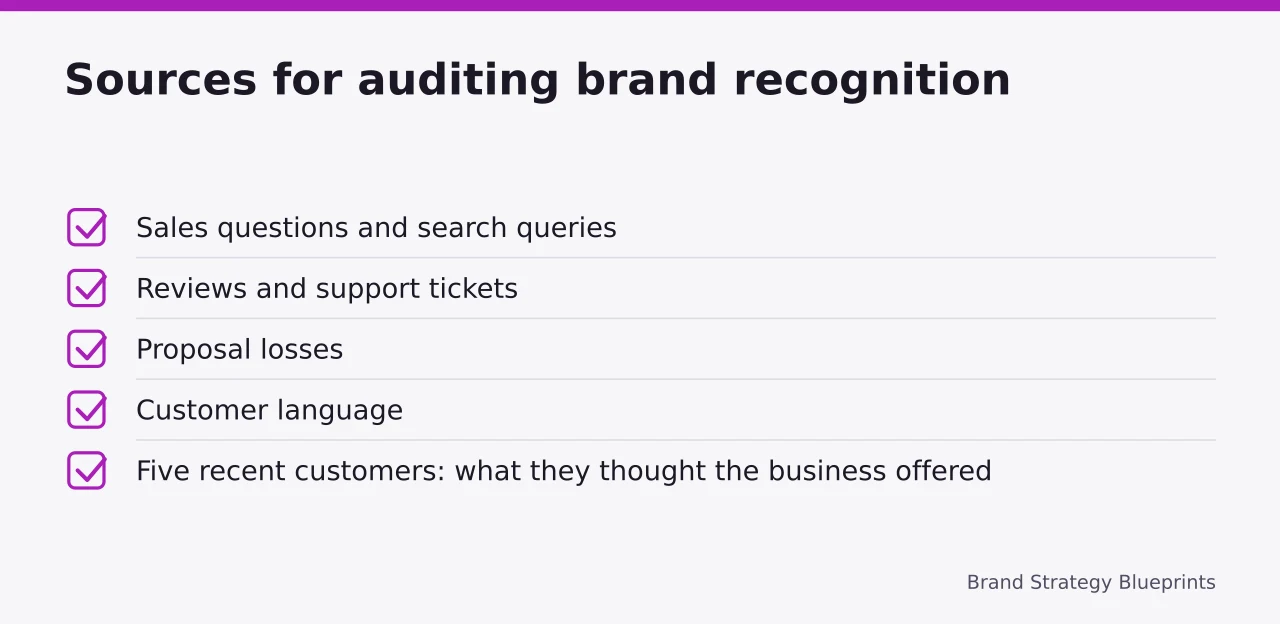
Collect sales questions, search queries, reviews, support tickets, proposal losses, and customer language. Ask five recent customers what they thought the business offered before buying and what made it credible. Record contradictions. Do not replace weak research with an internal preference survey.
Tighten the position
Write one sentence naming the audience, problem, offer, method, and proof. An invented example, for illustration only: we help independent dental practices that lose bookings to no-shows by running reminder systems that we install in two weeks, with references from practices we already serve.
Remove claims that could fit any competitor. State poor-fit work honestly. A narrower position gives the homepage, sales conversation, content plan, and referral partners a shared explanation. The marketing frameworks guide covers how to choose the framework that organizes that explanation.
Improve the proof
The FTC's advertising substantiation policy statement explains that advertisers need a reasonable basis for express and implied objective claims before dissemination. For a small business owner, that means the claim you publish is a claim you may have to defend.
The required support depends on factors such as the claim, product, consequences of error, available substantiation, and what experts in the field consider reasonable. Review the complete impression, preserve the evidence, and obtain qualified advice for high-risk claims.
Replace inflated adjectives with verified process, qualifications, samples, time frames, case context, and customer outcomes. Obtain permission and explain limitations. Separate a customer's actual experience from the business's broader performance claim, and never invent a testimonial or conceal a material relationship. A marketing planning checklist helps keep proof, permissions, and limitations from drifting as materials multiply.
Repair the visual system
W3C's explanation of WCAG minimum text contrast describes a 4.5:1 minimum for ordinary text and 3:1 for qualifying large text under that success criterion, with listed exceptions. For a small business owner, contrast is the cheapest fix on this list, and it decides whether some customers can read the offer at all.
Those ratios do not complete an accessibility review. Test states, controls, zoom, images, documents, language, keyboard use, and assistive-technology workflows that matter to the real audience and product.
Test the logo, type, colors, photography, buttons, charts, and templates in real conditions. Prepare compact, monochrome, dark-background, print, and small-size variants instead of stretching one file everywhere. Check ordinary text, controls, states, and informative graphics separately from the logo itself.
Make public facts agree
Reconcile the business name, offer, contact details, hours, service area, staff descriptions, prices, and imagery across the site, maps, directories, social profiles, email, invoices, proposals, and signage. Assign one approved source of truth and an owner for correcting live disagreements.
Run a monthly review
Put the checks on a calendar rather than on memory. Once a month, review expired information, access, customer feedback, and the measure chosen for the change. Assign corrections and archive replaced assets. Improvement comes from a clearer promise kept across repeated interactions, not from frequent cosmetic reinvention.
Test one change at a time
Invented worked example: a two-person bookkeeping firm rewrites the homepage headline to name its audience and their problem. Before, the headline reads Accounting for growing businesses and names no audience. After, it names the audience, the problem, the offer, the method, and the proof.
Baseline: qualified quote requests in the 90 days before the change. Measure: qualified quote requests, meaning inquiries that match the target audience and state a size and a deadline. Window: the 90 days after.
Compare the same months a year apart so tax season does not distort the result. If unqualified inquiries rise while qualified quotes hold flat, the headline pulled the wrong audience.
Time and cost depend on the change. An owner can rewrite a headline in an afternoon; new templates or photographs take longer and often need paid help. This article gives no price list, because the cost depends on the scope of the work.
A useful test window covers one full buying cycle plus a repeat. The buying cycle, the number of quotes you need, and seasonal swings decide how long that takes.
Brand improvement sequence
| Signal | Likely cause | First repair |
|---|---|---|
| Confused inquiries | Vague position or message | Clarify audience and offer |
| Low trust | Weak proof or hidden limits | Verify evidence and context |
| Inconsistent use | Missing files or ownership | Publish rules and permissions |
| No clear result | No baseline or decision rule | Define measure and test |
When a rebrand is the next step
A rebrand usually covers the name, logo, typography, colour, templates, and rollout across every channel. Start with the name, because it is the one part you cannot quietly undo. Search the USPTO trademark database for the name and close variants before printing anything, since a name that another business already holds can force a change later.
Hold the rebrand until the position and proof above are settled. A new logo over an unclear promise only makes the confusion look newer. Once the position holds, roll the new identity out in stages and keep the old files on hand until every channel is updated.
Common questions
What should a small business improve first?
Correct an inaccurate promise, unsafe name, inaccessible customer path, contradictory public fact, or broken service handoff before making cosmetic changes.
Should a business change its logo to improve branding?
Only when evidence shows the mark creates a real recognition, usability, rights, production, or strategic problem that a controlled change can solve.
How long should a brand improvement test run?
Use a period long enough for the real buying cycle and sufficient evidence, with a baseline, comparable window, change log, and stop rule.
Does the worked example show a real result?
No. The two examples in this article are invented to show the method. Run the same steps on your own inquiries, and record the baseline and the result before you judge the change.